 ML Specialization
Gradient Descent
This section covers Gradient Descent, the optimization engine that powers many machine learning models.
Gradient Descent is a powerful optimization algorithm that isn't limited to linear regression. It can be applied to more general functions with many parameters.
The Goal of Gradient Descent
The primary goal is to find the values for the model parameters (e.g., and ) that minimize the cost function .
Goal: over
The Algorithm
The process is intuitive:
- Initialize: Start with some initial values for your parameters and (e.g., , ).
- Iterate: Repeatedly adjust and in a direction that reduces the cost .
- Converge: Stop when the algorithm settles at or near a minimum, where the cost no longer decreases significantly.
This can be visualized as walking downhill on a graph of the cost function until you reach the lowest point.
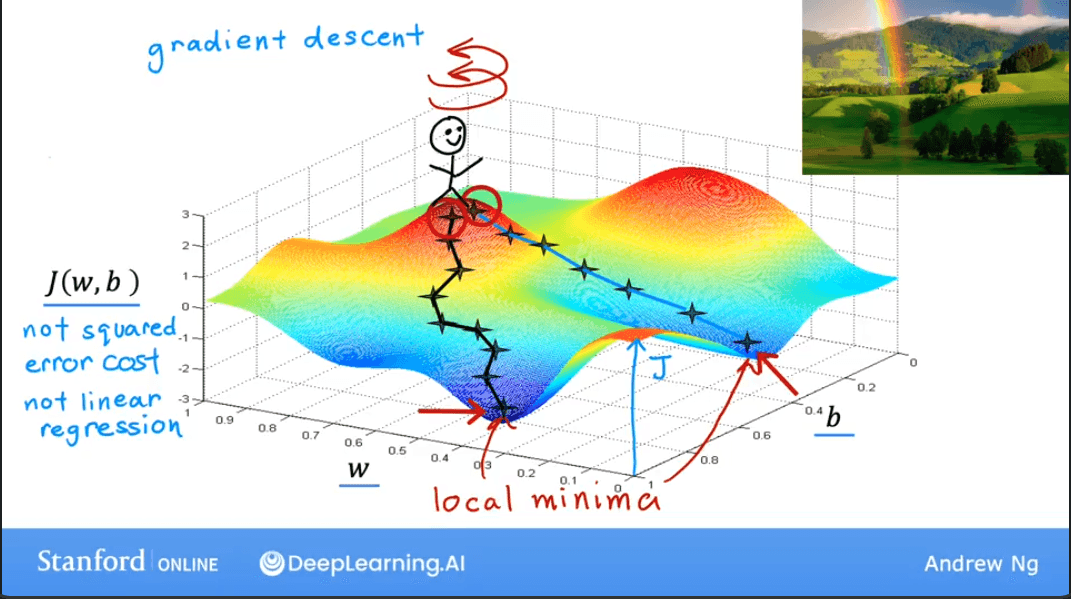
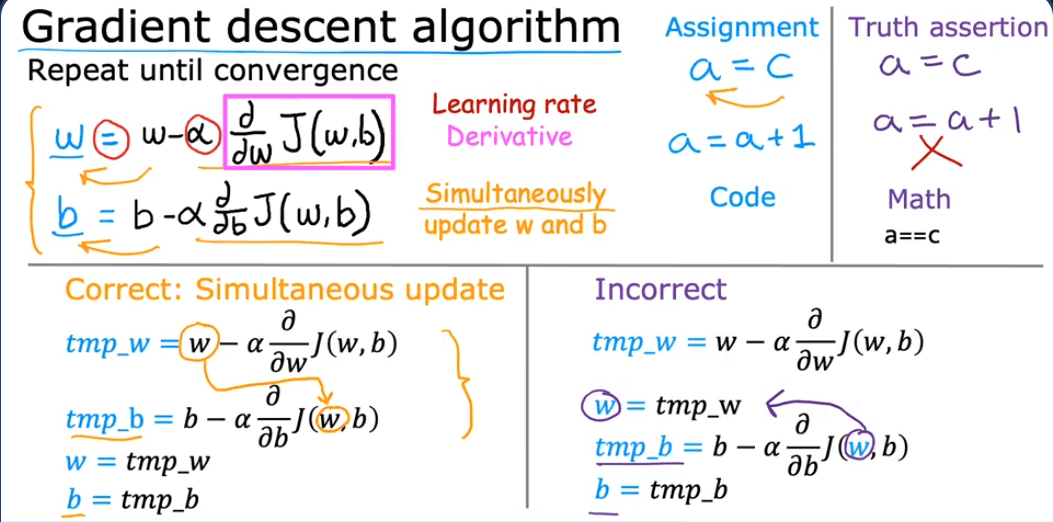
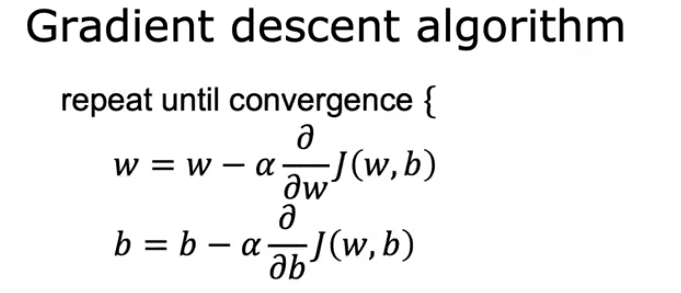
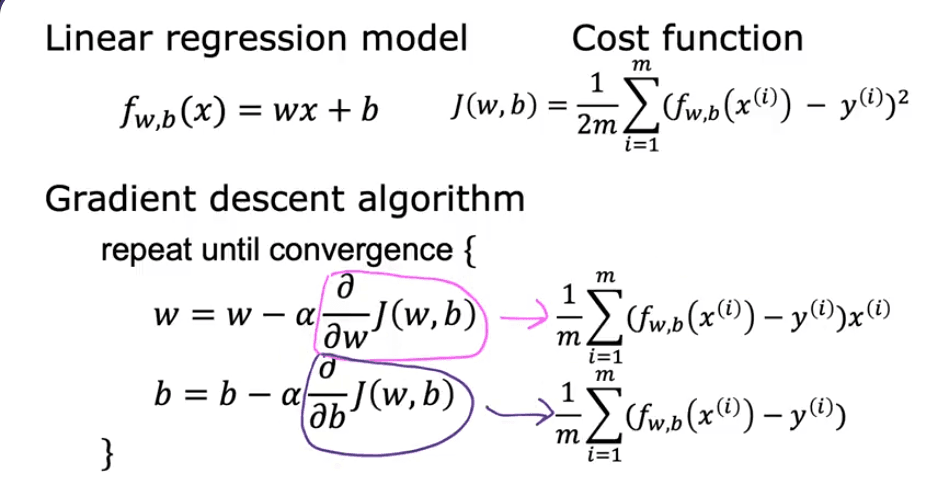
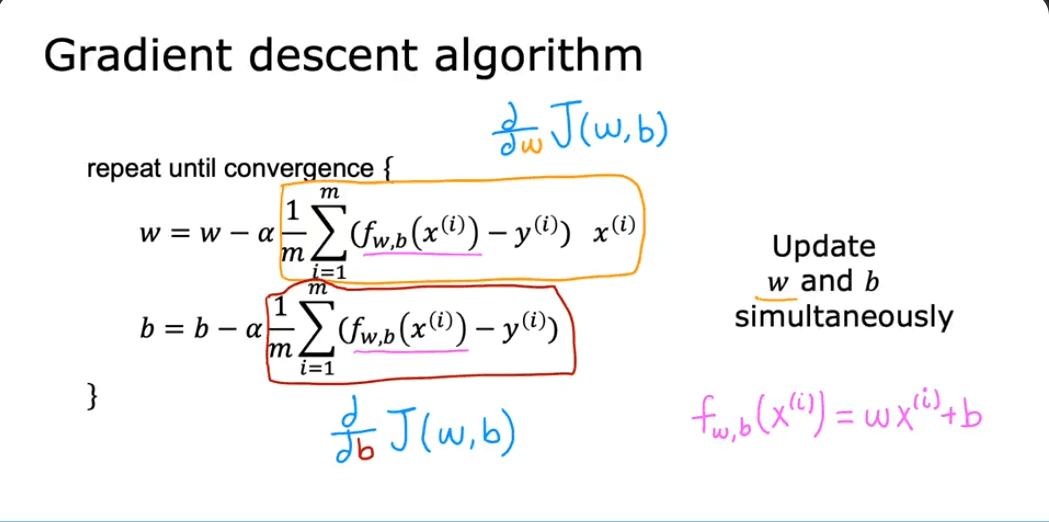
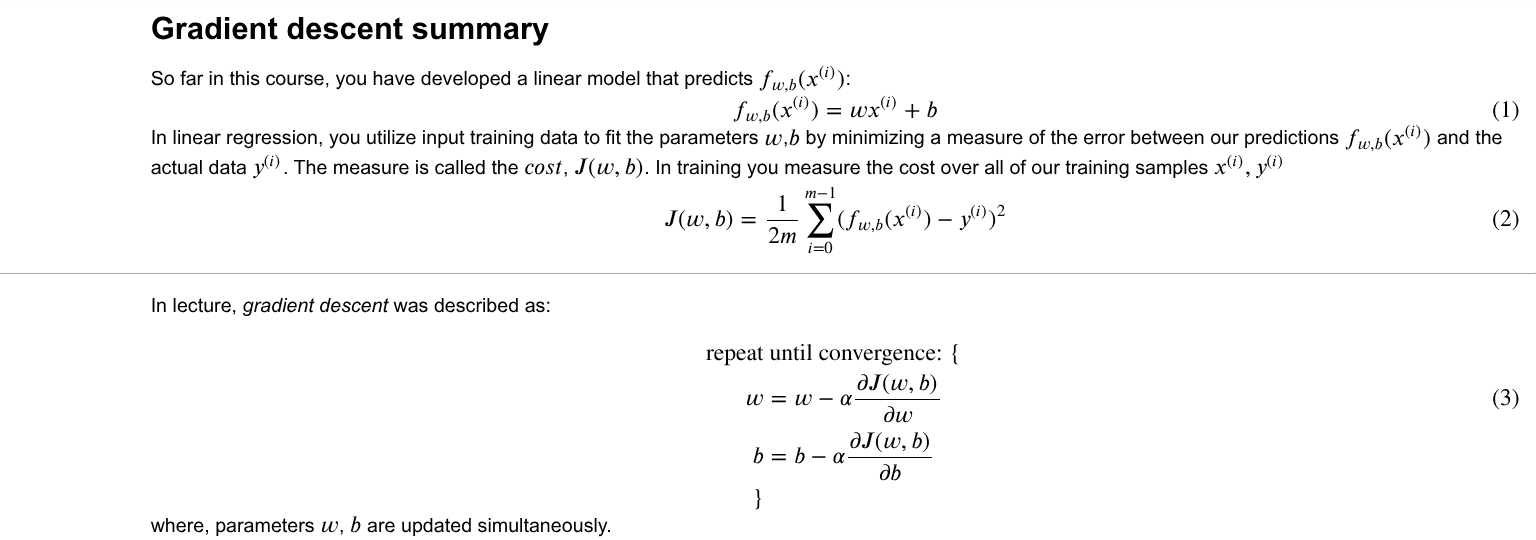
The core of the algorithm involves simultaneously updating the parameters and using their partial derivatives with respect to the cost function.
- : The model parameters.
- : The learning rate, a positive scalar that controls the size of each step.
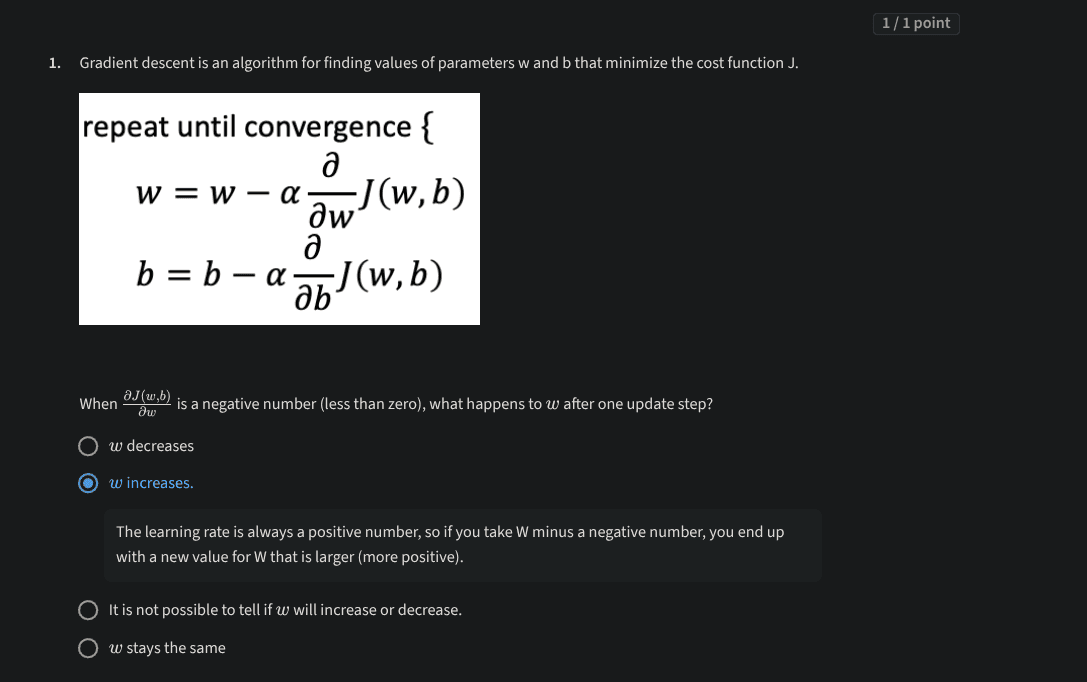
- : The partial derivative (or gradient) of the cost function with respect to . This tells us the slope of the cost function in the direction.
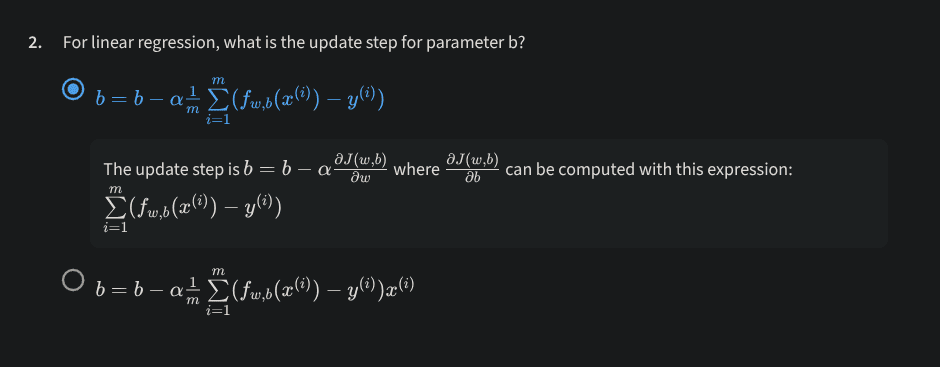
- : The partial derivative of the cost function with respect to .
The Importance of the Learning Rate ()
Choosing the right learning rate is crucial for the success of Gradient Descent.
- If is too small: The algorithm will take very slow, tiny steps, leading to a long convergence time.
- If is too large: The algorithm might "overshoot" the minimum, causing the cost to oscillate or even increase. In the worst case, it can diverge, with the cost growing indefinitely.
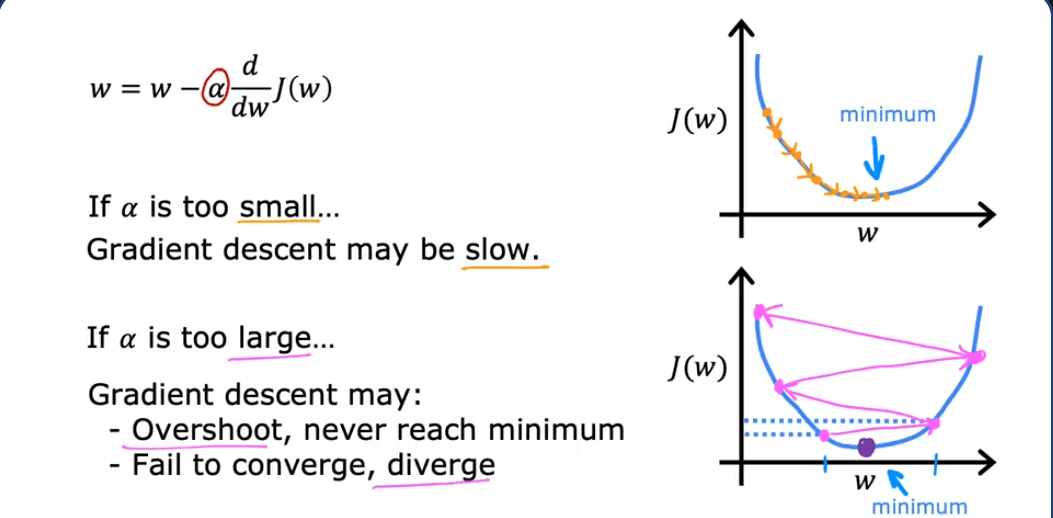
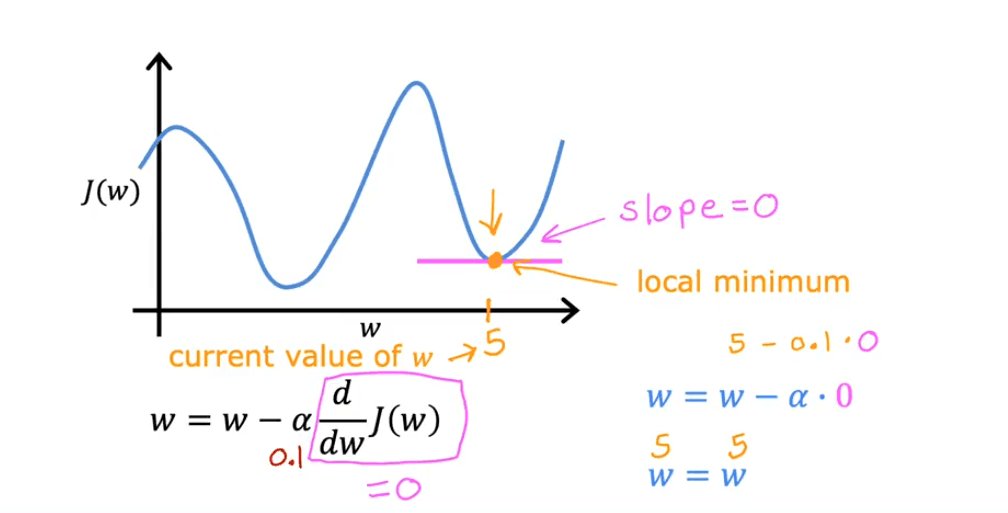
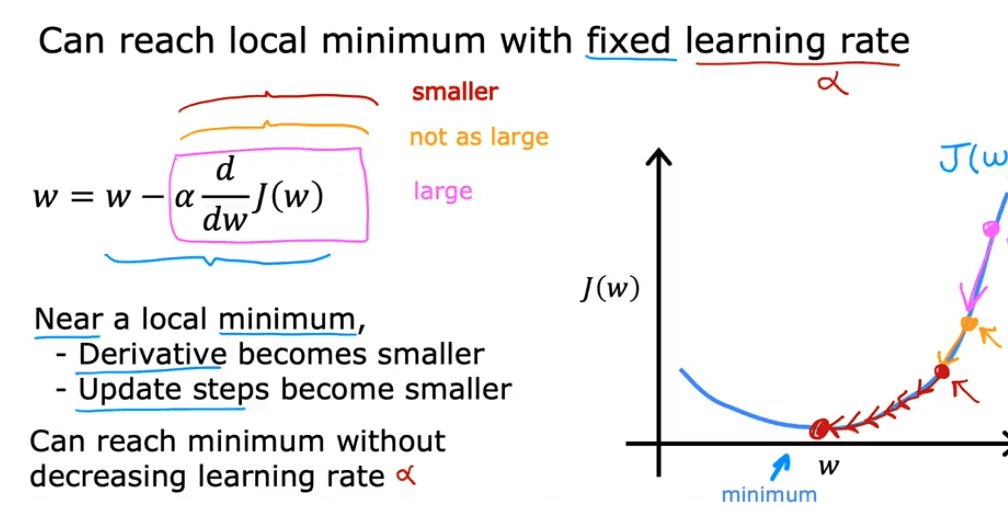
A key feature of Gradient Descent is that as it approaches a local minimum, the slope (derivative) of the cost function naturally gets smaller. This means the update steps (α * derivative) automatically become smaller, allowing the algorithm to fine-tune its position without overshooting the minimum.
Here's a recap of the formulas involved:
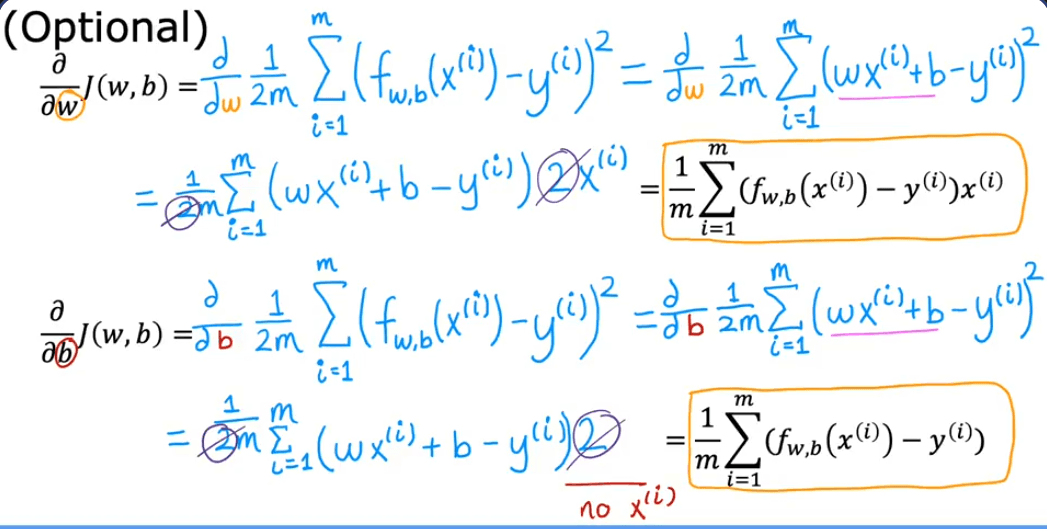
And the derivation for the gradient components:
Gradient Descent for Linear Regression
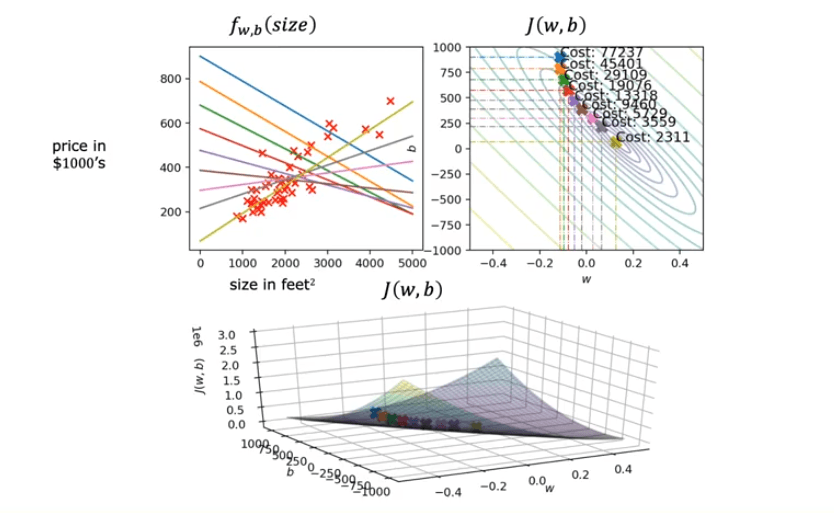
When we use Gradient Descent with a Squared Error Cost Function (the standard for linear regression), the cost function is convex.
Note: A convex function is a "bowl-shaped" function that has no local minima—it only has one single global minimum. This is a very important property, as it guarantees that Gradient Descent, given a suitable learning rate, will always converge to the best possible solution (the global minimum) and not get stuck in a suboptimal local minimum.

Batch Gradient Descent
The version of Gradient Descent described here is known as Batch Gradient Descent. The term "batch" refers to the fact that every single training example from the dataset is used to compute the gradient in each step of the descent.
Note: This is in contrast to other variants like Stochastic Gradient Descent (SGD), which uses a single example per step, and Mini-Batch Gradient Descent, which uses a small subset (a mini-batch) of examples. Batch Gradient Descent is computationally expensive for large datasets but provides a more stable and direct path to the minimum.
Knowledge Check
Test your understanding with these questions.
Python Implementation
Here is a complete Python implementation of Gradient Descent for a simple linear regression model.
import math, copy
import numpy as np
import matplotlib.pyplot as plt

# Use a pre-defined style for plots
plt.style.use('./deeplearning.mplstyle')
# Utility functions for plotting, provided by the course
from lab_utils_uni import plt_house_x, plt_contour_wgrad, plt_divergence, plt_gradients

# -------------------------------------------
# 1. Load and Visualize the Data
# -------------------------------------------
x_train = np.array([1.0, 2.0])   # features (size in 1000s of sqft)
y_train = np.array([300.0, 500.0])   # target value (price in 1000s of dollars)

# -------------------------------------------
# 2. Define Core Functions
# -------------------------------------------

def compute_cost(x, y, w, b):
    """
    Computes the cost function for linear regression.

    Args:
      x (ndarray (m,)): Data, m examples
      y (ndarray (m,)): target values
      w,b (scalar)    : model parameters
    Returns
      total_cost (float): The cost of using w,b as the parameters for linear regression
                          to fit the data points in x and y
    """
    m = x.shape[0]
    cost_sum = 0
    for i in range(m):
        f_wb = w * x[i] + b
        cost = (f_wb - y[i])**2
        cost_sum += cost
    total_cost = (1 / (2 * m)) * cost_sum
    return total_cost

def compute_gradient(x, y, w, b):
    """
    Computes the gradient for linear regression.

    Args:
      x (ndarray (m,)): Data, m examples
      y (ndarray (m,)): target values
      w,b (scalar)    : model parameters
    Returns
      dj_dw (scalar): The gradient of the cost w.r.t. the parameter w
      dj_db (scalar): The gradient of the cost w.r.t. the parameter b
    """
    m = x.shape[0]
    dj_dw = 0
    dj_db = 0

    for i in range(m):
        f_wb = w * x[i] + b
        dj_dw_i = (f_wb - y[i]) * x[i]
        dj_db_i = f_wb - y[i]
        dj_dw += dj_dw_i
        dj_db += dj_db_i
    dj_dw = dj_dw / m
    dj_db = dj_db / m

    return dj_dw, dj_db

def gradient_descent(x, y, w_in, b_in, alpha, num_iters, cost_function, gradient_function):
    """
    Performs gradient descent to fit w,b. Updates w,b by taking
    num_iters gradient steps with learning rate alpha.

    Args:
      x (ndarray (m,))  : Data, m examples
      y (ndarray (m,))  : target values
      w_in,b_in (scalar): initial values of model parameters
      alpha (float):     Learning rate
      num_iters (int):   number of iterations to run gradient descent
      cost_function:     function to call to produce cost
      gradient_function: function to call to produce gradient

    Returns:
      w (scalar): Updated value of parameter after running gradient descent
      b (scalar): Updated value of parameter after running gradient descent
      J_history (List): History of cost values
      p_history (list): History of parameters [w,b]
    """
    J_history = []
    p_history = []
    b = b_in
    w = w_in

    for i in range(num_iters):
        # Calculate the gradient and update the parameters
        dj_dw, dj_db = gradient_function(x, y, w, b)

        # Update Parameters
        b = b - alpha * dj_db
        w = w - alpha * dj_dw

        # Save cost J at each iteration
        if i < 100000: # prevent resource exhaustion
            J_history.append(cost_function(x, y, w, b))
            p_history.append([w,b])

        # Print cost every 10% of the way through
        if i % math.ceil(num_iters/10) == 0:
            print(f"Iteration {i:4}: Cost {J_history[-1]:0.2e} ",
                  f"dj_dw: {dj_dw: 0.3e}, dj_db: {dj_db: 0.3e}  ",
                  f"w: {w: 0.3e}, b:{b: 0.5e}")

    return w, b, J_history, p_history #return history for graphing

# -------------------------------------------
# 3. Run Gradient Descent and Analyze
# -------------------------------------------

# -- Run with a good learning rate --
print("--- Running Gradient Descent with a good learning rate (alpha=0.01) ---")
w_init = 0
b_init = 0
iterations = 10000
tmp_alpha = 1.0e-2

w_final, b_final, J_hist, p_hist = gradient_descent(x_train ,y_train, w_init, b_init, tmp_alpha,
                                                    iterations, compute_cost, compute_gradient)
print(f"\n(w,b) found by gradient descent: ({w_final:8.4f}, {b_final:8.4f})")

# -- Run with a bad learning rate (too high) --
print("\n--- Running Gradient Descent with a large learning rate (alpha=0.8) to show divergence ---")
w_init_diverge = 0
b_init_diverge = 0
iterations_diverge = 10
tmp_alpha_diverge = 8.0e-1

# This will likely produce NaNs or very large numbers, demonstrating divergence
w_final_d, b_final_d, J_hist_d, p_hist_d = gradient_descent(x_train, y_train, w_init_diverge, b_init_diverge,
                                                            tmp_alpha_diverge, iterations_diverge,
                                                            compute_cost, compute_gradient)

# -------------------------------------------
# 4. Visualize Results
# -------------------------------------------

# Plot cost vs. iteration
fig, (ax1, ax2) = plt.subplots(1, 2, constrained_layout=True, figsize=(12, 4))
ax1.plot(J_hist[:100])
ax2.plot(1000 + np.arange(len(J_hist[1000:])), J_hist[1000:])
ax1.set_title("Cost vs. iteration (start)")
ax2.set_title("Cost vs. iteration (end)")
ax1.set_ylabel('Cost')
ax2.set_ylabel('Cost')
ax1.set_xlabel('iteration step')
ax2.set_xlabel('iteration step')
plt.show()

# Make predictions with the final parameters
print(f"1000 sqft house prediction {w_final*1.0 + b_final:0.1f} Thousand dollars")
print(f"1200 sqft house prediction {w_final*1.2 + b_final:0.1f} Thousand dollars")
print(f"2000 sqft house prediction {w_final*2.0 + b_final:0.1f} Thousand dollars")

# Plot the contour plot to visualize the path of gradient descent
fig, ax = plt.subplots(1, 1, figsize=(12, 6))
plt_contour_wgrad(x_train, y_train, p_hist, ax)
plt.show()

# Plot the divergence caused by a high learning rate
plt_divergence(p_hist_d, J_hist_d, x_train, y_train)
plt.show()
📋 Recap Summary
These notes provide a final, condensed overview of the key concepts of Gradient Descent.

Linear Regression
This section covers Linear Regression, a foundational concept in Supervised Learning.
Multiple Linear Regression
This section covers linear regression with multiple input variables, the concept of vectorization for computational efficiency, a practical guide to the NumPy library, and a hands-on lab implementation.